
Policy Statement
- To promote human rights protection and education among faculty and staff, students and administrators.
- To join with existing human rights groups within the community for the purpose of exchange of information and the promotion of strengthened human rights protection in BC.
- To preserve and enhance fundamental standards of humanity, peace and human rights legislation, on the national as well as the international level.
- To work cooperatively with national and international NGOs and labour organizations whose mandate it is to promote human rights worldwide, as peace is essential to ensuring the quality of life.
Responsibilities
- To encourage the formation of an active Human Rights Committee in each local.
- To ensure that sufficient human rights protection is available to members through improvement of provisions of collective agreements and the establishment of policies in colleges and institutions.
- To help members utilize existing human rights legislation, in conjunction with the collective agreement, to prevent discrimination.
- To provide resources and education on human rights legislation and issues.
- To join with other groups/individuals in the community to support issues of mutual interest, with the approval of Presidents’ Council.
- To monitor the progress of human rights protection in the members’ institutions.
- To recommend to Presidents’ Council that the committee liaise with specific local, provincial, national and international organizations which advocate for international solidarity on global justice and human rights issues and, where Presidents’ Council agrees, to do that liaising.
- Recognizing the limited resources of FPSE and the scope of human rights issues, the Human Rights and International Solidarity Committee will:
a) inform and educate members on linkages between local and international human rights and international solidarity issues;
b) advise the Presidents’ Council on human rights and international solidarity issues; and
c) advocate for international solidarity on global justice and human rights issues. - To appoint two members to the International Solidarity Fund Committee.
Terms of Reference
- Reporting to: Reports regularly to the FPSE President and the Presidents’ Council.
- Composition: The Human Rights & International Solidarity Committee is composed of one designated representative from each local. A member will be appointed by the Executive Committee, with voice but without vote, to act as liaison between the Standing Committee, the Executive, and Presidents’ Council. The Non-Regular Faculty Committee may appoint one person to the Committee. Locals should consider including their HRISC member on their local Executive.
- Term of Appointment: Locals shall endeavour to elect or appoint representatives for a two year term.
- Meetings: Such meetings as are required to fulfill its responsibilities, limited only by the funding allocated to the Committee. The Committee may substitute or include a workshop or conference for a meeting.
- Chairperson: The Committee shall elect a new Chairperson at the last meeting of the Committee held prior to the convening of the Annual General Meeting and Convention. The Committee shall endeavour to elect a Chairperson who has served on the Committee a previous term as a local representative. The Chairperson or designate shall have observer status at meetings of the Presidents’ Council with voice but no vote. The responsibility of the Chairperson includes attendance by the Chairperson or designate at the Presidents’ Council meeting immediately subsequent to a meeting of the Committee or upon request of the FPSE President. The Chairperson shall attend the Annual General Meeting and Convention. The Convention shall provide orientation and planning opportunities for Committee Chairpersons and facilitate their meeting as a group. The duly elected Chairperson of the Committee must be the designated representative of a local to continue being Chairperson.
- Observers: By invitation of the Chair.
- Quorum: A majority of locals.
- Voting: Positions adopted by consensus among designated representatives; otherwise by simple majority of those voting (By-Law #6).
- Funds: As allocated in the annual budget.
Resources of Interest
General Interest


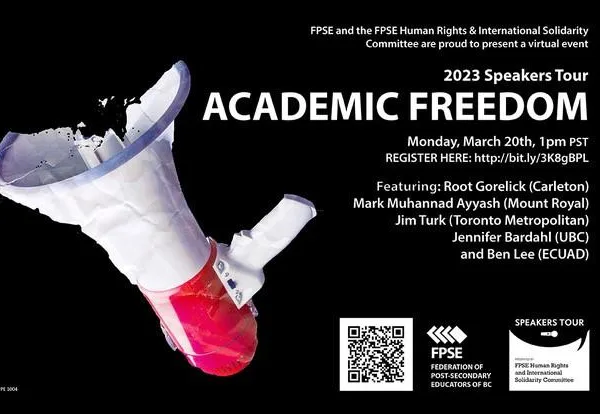
FPSE-HRISC Speakers Tour Recordings
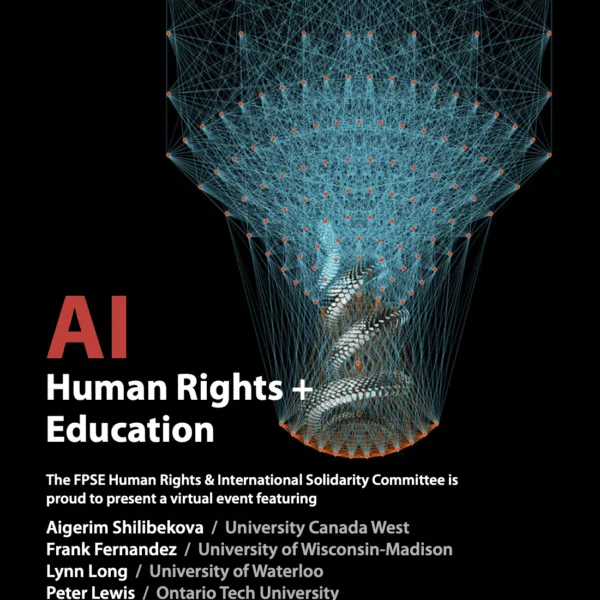
AI: Human Rights + Education

Human Rights Policy and Legislation
International Solidarity Fund
As our attention is drawn increasingly to human problems that are international in scope and nature – problems like global poverty and hunger, a global education deficit that sees more than 120 million children without basic schooling, climate change and resource depletion, and a rise in energy and resource-related warfare – unions have become increasingly active in working toward a new, global understanding of human rights and a new solidarity paradigm. Like many other labour organizations in BC and across Canada, we seek to engage in global solidarity causes. To that end, 2006 AGM delegates voted to establish an international solidarity fund.
Terms of Reference
Overview and motivation
The attention of informed union members has been drawn increasingly to human problems that are international in scope and nature. Problems like the scourge of global poverty and hunger, a global education deficit that sees more than 120 million children without basic schooling, climate change and resource depletion, and a rise in energy and resource-related warfare. At the same time, unions have become increasingly active in opposing coercive global trade agreements, in protesting the economic and political injustices of pro-corporate institutions like the World Bank, the IMF and the WTO, and in supporting the global peace movement. Capital flight to third world sweatshops and a shifting global division of labour have shown us that our interests are bound up with those of workers in the economically disadvantaged world. The maxim ‘what we desire for ourselves, we wish for all’ has come to have a new meaning. This new awareness calls on us to develop a new, global understanding of human rights and a new solidarity paradigm.
In May 2001, the FPSE (then CIEA) AGM adopted new terms of reference for the Federation’s Human Rights Committee. The committee was re-named the Human Rights and International Solidarity Committee (HRISC) and was mandated to advise the Federation on international solidarity issues and to assist it in implementing related policies and actions. Subsequently, the committee has recognized a need for a more deliberate, policy-based
approach to solidarity work.
FPSE is not alone. Other unions in BC are seeking to engage global solidarity issues more effectively. The British Columbia Government and Service Employees Union, the BC division of the Canadian Union of Public Employees, and the British Columbia Teachers’ Federation have put their international solidarity work on a more systematic footing. To that end, these unions have established international solidarity funds. These funds give recognition to the need to plan for stable, long-term solidarity relationships.
At the May 2006 AGM, the HRISC proposed and got approval in principle for the development of an FPSE international solidarity fund. At its November 2006 meeting, following an educational session on solidarity funds, HRISC struck a sub-committee to prepare a solidarity fund proposal. That proposal, amended and endorsed by the HRISC, is set out below.
Fund source
The fund will be 1.25 per cent of the annual dues of the previous fiscal year. Fundraising activities at the local or provincial level may supplement the fund.
Fund governance
An International Solidarity Fund Committee (ISFC), comprising the Secretary-Treasurer, two members elected by the Human Rights & International Solidarity Committee (HRISC), and two Presidents’ Council members, will make decisions on fund disbursements. Knowledge of human rights and international solidarity issues would be an asset for appointees to the ISFC.
International Solidarity Fund Committee members will be annually appointed by HRISC and Presidents’ Council. Appointing bodies will consider continuity when making appointments.
Funding proposals may be initiated by any member local or Presidents’ Council, Executive Committee or ISFC member. There will be a 45-day period between the call for proposals and the deadline for their receipt.
Disbursements of greater than $7000 will be subject to approval by Presidents’ Council. All disbursements will be itemized and reported to Presidents’ Council and HRISC at each meeting.
Basic outlook
The fund rests on the belief that we share experiences, needs and values with all members of the global community. We affirm that what we desire for ourselves, we wish for all others around the world.
International solidarity partnerships should be a two-way street. This means that while we can assist others in their local struggles for a decent life, respect and dignity, they can help us to understand better both our own situation and the consequences elsewhere of institutions and policies rooted in our own society.
International solidarity partnerships, as distinct from traditional charity efforts, stress linking to and supporting popular organizations working to advance human rights.
Understanding the human rights initiatives of others can place our own experiences and struggles in a broader perspective, one that allows us to see what our struggles have in common with others.
The right to an education is a gateway right, a right fundamental to the promotion of other human rights and to the promotion of well-being and dignity.
Objectives
The fund:
- promotes international solidarity projects and actions that support disadvantaged people organizing to realize their basic human rights, projects informed by the values of equality, respect, human dignity and social justice;
- supports the development of solidarity relationships that are appropriately enduring and stable;
- promotes building relationships with others seeking to advance the basic human right to education;
- promotes awareness of policies or institutions in economically advantaged countries like Canada and the US that foster human rights violations in other countries;
- seeks to inform and enliven the work of our locals and our Federation by encouraging our members to work in the disadvantaged world and by supporting our partners there to represent their work at FPSE meetings and functions.
- considers project continuity and prior relationship with FPSE as a way of providing sustained support, ensuring a long-lasting, stable relationship.
Activities
The fund will support projects and actions in economically disadvantaged countries that
- advance human rights, educators’ initiatives, workers’ rights, labour organizations and community development;
- have long-term scope and the potential to establish a long-standing funding relationship with FPSE;
- advance the right to a publicly-funded education;
- oppose neoliberal privatization and cuts in education;
- allow individual FPSE members to work directly in support of human rights;
- allow our partners in local communities to represent their work at FPSE meetings and functions;
- collaborate with other labour organizations in BC and Canada for agreed solidarity objectives;
- are housed or originate within an FPSE local, or have a demonstrated, long-standing relationship with an FPSE local;
- promote member education about social and economic conditions and popular efforts toward social justice;
- promote and strengthen our members’ abilities to teach about global justice issues;
- advocate to ensure a role for Canada in meeting the objectives of the ISF.
The fund will also support projects and actions that
- increase awareness of policies or institutions that violate the human rights of people in economically disadvantaged countries;
- assist organizations with people that work in economically disadvantaged regions in Canada and the United States.
The fund will not support travel or administrative costs.
Featured
Stay informed with timely and relevant information on FPSE activities and education sector news. Get essential resources to empower member Locals, providing education on rights, supporting contract negotiations, facilitating communication, and advocating for policy changes. Check out event calendar for member Local and FPSE events.
Events
Standing Committee Summit (virtual)
Academic Governance Committee (AGC) Climate Action Standing Committee (CASC) Human Rights and International Solidarity Committee (HRISC) Non-Regular Faculty Committee (NRFC) Women and Gender Equity Committee (WGEC)
Standing Committee Summit (virtual)
Bargaining Coordination Committee (BCC) Disability Management and Rehabilitation Committee (DMRC) Workplace Health, Safety, and Environment Committee (WHSEC) Pension Advisory Committee (PAC)
Standing Committee Summit (in person)
Academic Governance Committee (AGC) Climate Action Standing Committee (CASC) Human Rights and International Solidarity Committee (HRISC) Non-Regular Faculty Committee (NRFC) Women and Gender Equity Committee (WGEC)